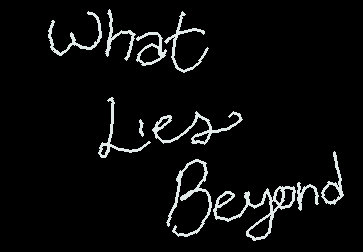
What Lies Beyond
What Lies Beyond
Nathaniel Luis Urieta, 2025
This Game was developed as part of the final assignment for the course ENG 328 Writing for Games and Narrative Design (Fall 2025), University of Toronto Mississauga. The work was supervised by Professor Bruno R. Véras, Assistant Professor, LTA, Game Studies Program, Department of English and Drama, UTM.
Abstract
Have you ever wondered what lies beyond? In this interactive visual novel, piece together the life stories of four individuals and their encounter with a mysterious psychopomp. Find out who lives, who suffers, and who is rewarded for the rest of eternity among What Lies Beyond
Authored Design Statement
What Lies Beyond is a Twine visual novel about entering the afterlife. The player encounters an entity that greets them from beyond the grave and asks them questions. Each question yields different results and paints a different picture of the person. Though not apparent at first, each route leads to a different character’s story, taking on distinct appearances and identities once their backstory has been fully painted. There are four character stories, and the player navigates them as they face the rewards or consequences of their actions in life. The point of the game isn’t necessarily to convince people that there is an afterlife, but to maybe consider that the consequences of their actions can catch up to them any day.
The game was designed through a combination of blue sky thinking and prototyping. I had trouble figuring out exactly what I wanted to write for the story, so I decided to just start making paths in Twine. Blue Sky thinking entails focusing on quantity over quality, writing everything down, and welcoming any and all ideas. As a result, I listed all my ideas directly in Twine’s branching paths and finished with 4 paths with distinct themes, all related to the afterlife. One of the paths had the weird idea of trying to date the entity that greets you beyond the grave - a Charon-like figure. One of the challenges was managing all the branching narratives, but this was solved by giving the player the option to steer the path through certain options, allowing them to reach the same conclusion from certain sets of paths and decisions, making it easier to manage. I also normally start with a top-to-bottom game design approach, starting with the visuals and theming, as I’m a visual artist and graphic designer. But since Twine's format wasn't exactly my specialty, I did the opposite and started making the game. This applies to Tomasz Queiroz’s Traps that Block Your Game (#5), which was making your prototype too pretty. Thinking about visuals slowed me down at first, but I realized what mattered most was actually the writing itself.
The game’s main character, the entity, speaks in a monotonous, intentionally stiff, and emotionless tone to convey the impression of a very neutral, godlike character. They present everything to the player as if they have a choice about where they may end up in the afterlife, and they do not force anything on the players. This means that anything that happens to the player is completely up to them. Players dictate any type of characterization of the character they play. Visually, I was inspired by the style and aesthetics of the original Hollow Knight game. It is dark with lots of glowing white elements, meant to give a hazily eerie yet calm feeling.
Henry Jenkins’ writings on Enacting Stories state that there is a certain expectation among critics regarding narratives in games: they need to integrate every element into the story, while simultaneously being fearful of player participation. Players decide whether the story is successful, regardless of how well it is written. Something I learned when working on this game is that games don’t need to start with a character. The protagonist, or player character, exists only as a consequence of the player's decisions, integrating narrative into gameplay rather than the other way around. Instead of narratives depending on the game elements, the game elements depend on the narrative.
I learned that what matters most when making a game is making it exist first. By leaving it for too long, trying to think of good ideas, I ended up sacrificing time that could've been spent on polishing and lengthening the story. As it turned out, the ideas came to me as I started working on it instead. Additionally, I learned that being able to see all the narrative paths in Twine made it much easier to see exactly where the story needed to head and to find points where it could easily split.
Works Cited
Jenkins, Henry. “Game Design as Narrative Architecture.” Publications, web.mit.edu/~21fms/People/henry3/games%26narrative.html. Accessed 24 Nov. 2025.
Lemarchand, Richard. A Playful Production Process: For Game Designers (and Everyone), MIT Press, 2021. ProQuest Ebook Central.
Queiroz, Tomasz. 10 Traps That Block Your Game, 2025