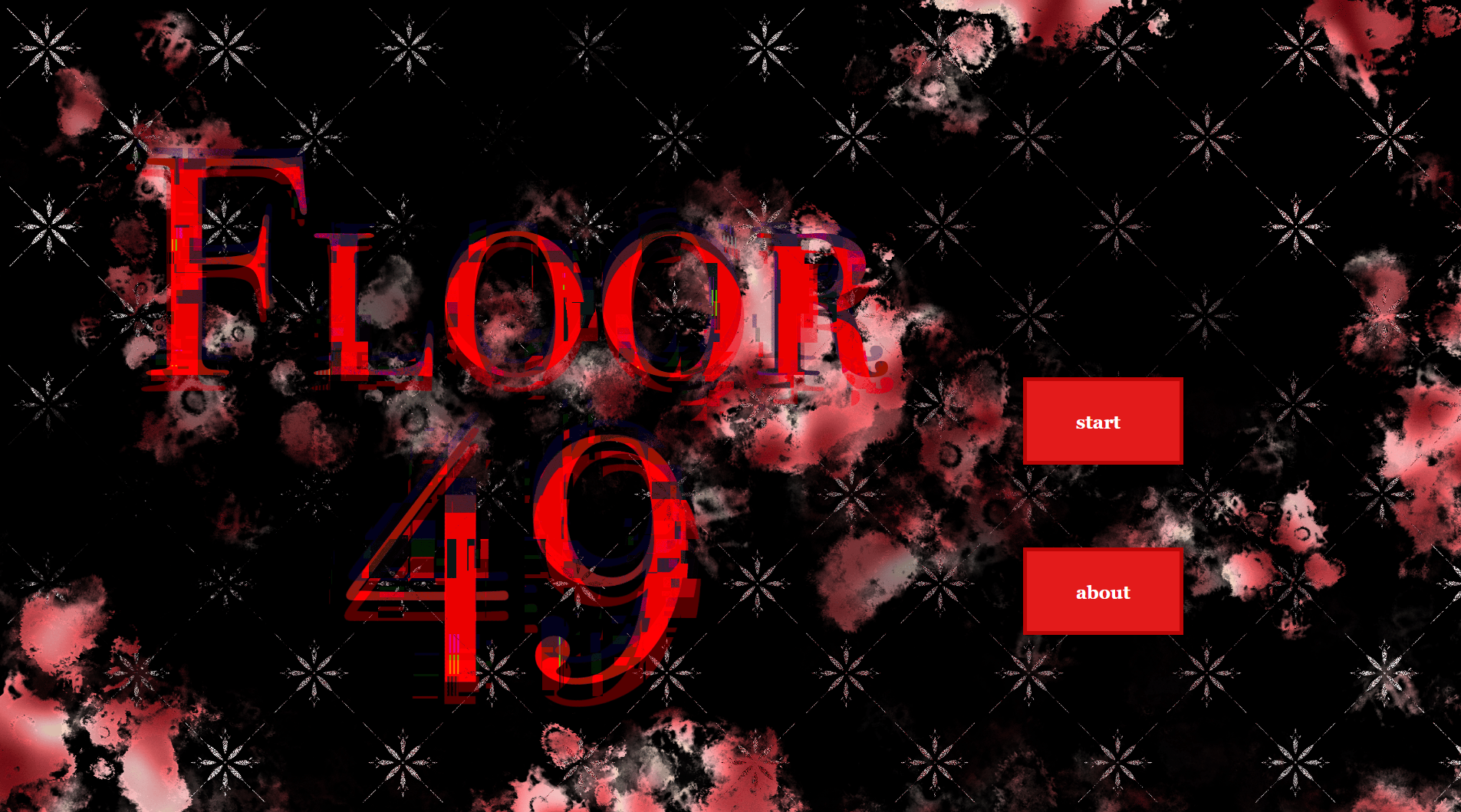
Floor 49
Floor 49
Brianna Zhao and Kitty Jiang, 2025
This Game was developed as part of the final assignment for the course ENG 328 Writing for Games and Narrative Design (Fall 2025), University of Toronto Mississauga. The work was supervised by Professor Bruno R. Véras, Assistant Professor, LTA, Game Studies Program, Department of English and Drama, UTM.
Abstract
Floor 49 is a Rules horror interactive narrative game. In the game, you play as an employee returning home from work. But something seems off… You somehow stumbled into a strange and horrific world. Will you make it home alive?
Authored Design Statement
Something that inspired us is the rules horror genre. The horror genre often unfolds in an ordinary scenario that people encounter every day, but with eerie rules one must follow to survive. For our game “Floor 49”, we have set the scene as the elevator of the protagonist’s apartment. The theme and issue our game explores are workplace exploitation and mental health. The message we want to convey to our players is that they should not let work invade their lives. Our protagonist is struggling to maintain that barrier to focus on themselves rather than on the opinions and views of those around them.
During the development of the game, we have brainstormed and tested multiple times. When starting to brainstorm, we actually started with a totally different idea with the concept of the backrooms, but then we decided that it was too big a workload. Then we changed the game to a rules horror. One major challenge we have encountered during our process is the coding part. We wanted our game to be different from all the other Twine games; we spent hours making it look like an actual visual novel rather than a point-and-click text game. Not only that, but the code often refused to cooperate, making it very difficult to continue working. Luckily, hard-coding exists.
For the art style, we chose to use cool, relatively sick colours (and variations), combining really dull, dark colours with bright, saturated ones. Most of our characters are in this colour palette, while our backgrounds are mostly dark. We aim to evoke a sense of depression and make the characters stand out. The narrative uses dark humour, combining violent actions with humorous narration. We chose this narration style because we want our players to experience some comedic elements in the game.
One concept relating to our game is “player emotions” from the book “Character Development and Storytelling for Games” by Lee Sheldon. Player emotions occur when the content of a game can control the player’s mood by creating a feeling of empathy (Sheldon, p. 211-212). Since our game relies heavily on narrative mechanics, immersion is important for triggering player emotions. We started the game by asking the player their pronouns to strengthen the connection between the player and the protagonist. Then we make genderless characters to create an inclusive feeling. After creating the base framework for triggering player emotions, we start to focus on rendering the depressing atmosphere. By using both narration and visuals, we place players in the protagonist's shoes. Now the player can see the protagonist as a projection of self, when making choices, they have to take on the responsibilities of the consequences.
Overall, we really enjoy the process of making the game, and we love the outcome; it actually achieved our expectations. During the process, we have learned that in order to achieve a better gameplay experience, it is important to have other people test your game. By receiving the comments from actual players, we can see the issues we tend to ignore as creators. In the future, we would like to add more paths and details if we have the chance.
Works Cited
Sheldon, Lee. “Story Anatomy.” Character Development and Storytelling for Games, Boca Raton, 2022, pp. 211–212.